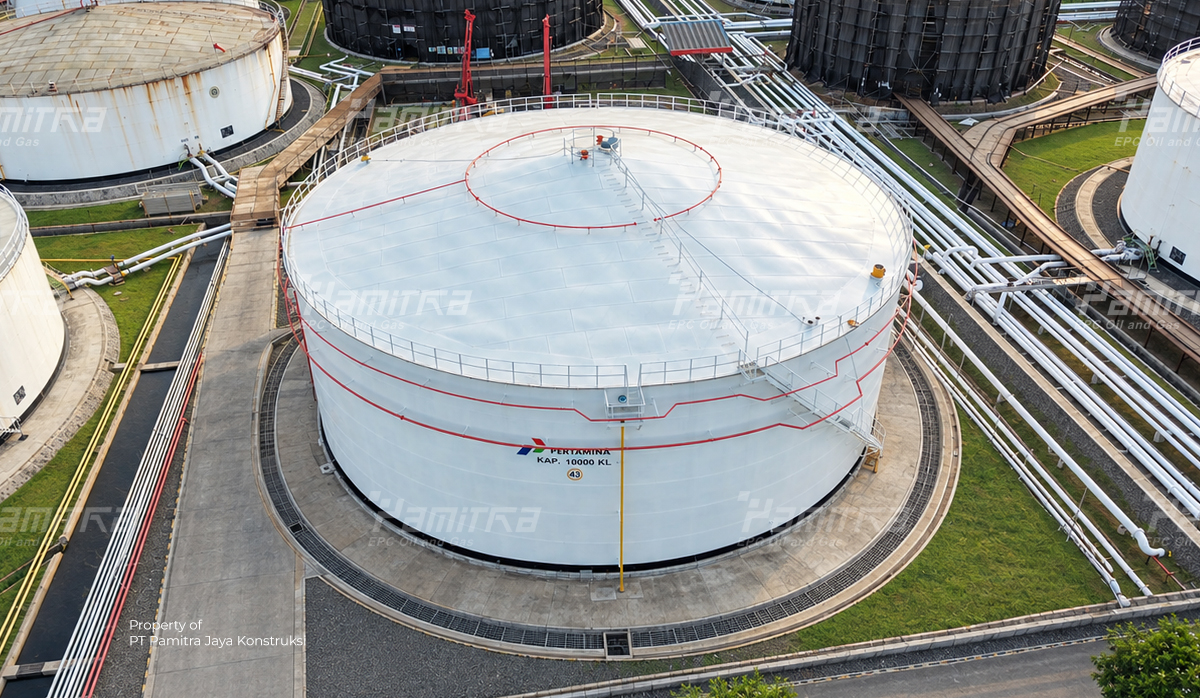
Surabaya, September 19, 2026 - Following the completion of the construction works and joint physical inspection, the 10,000 KL T-43 Tank containing Pertalite at Integrated Terminal Surabaya Group has entered the commissioning stage. This commissioning process represents a critical phase in ensuring the system’s readiness and the tank’s reliability prior to supporting operational activities. Prior to the commissioning, the readiness of T-43 Tank was confirmed through the completion of Mechanical Completion, punch list clearance, and the implementation of the Pre-Startup Safety Review (PSSR). In addition, the commissioning procedures and emergency response procedures were verified and adjusted to reflect the actual conditions at the site.
Commissioning Implementation
The commissioning sequence commenced at 08:45 WIB with a safety briefing attended by all relevant personnel, including representatives from the Integrated Terminal, DRE Pertamina Patra Niaga, and PT Pamitra Jaya Konstruksi. The process continued with a final inspection of all product line connections. Each opening was inspected and confirmed to be properly closed and ready for the product transfer process. At 09:00 WIB, the process proceeded to the product transfer stage with the opening of the gate valve on the T-43 inlet line, followed by an inspection of the Slot Dipping Device (SDD). At 09:10 WIB, the installation of the Pressure Gate on the T-43 inlet line was completed, and the system was declared ready to receive Pertalite. At 09:12 WIB, Pertalite began entering T-43 Tank through the inlet line using the intertank transfer method from T-53 to T-43 via the Southern Manifold. The gate valve was opened gradually while the flow rate was continuously monitored throughout the process. The flow rate was recorded at 235 KL/hour at 09:30 WIB, increasing to 356 KL/hour at 40% valve opening, and reaching 454 KL/hour at 50% valve opening. This figure represented the maximum flow rate achieved during the initial transfer stage. At 12:08 WIB, the product level reached 905 mm. The valve at the Southern Manifold was subsequently closed to proceed to the holding stage.
Holding and Leak Check
During the commissioning process, inspections were carried out on the piping system and T-43 Tank to verify that there were no indications of leakage. The inspection results confirmed that no leakage indications were identified within the system. The holding process was then continued for one hour. Sounding was conducted at 12:25 WIB and repeated after the completion of the holding period at 13:25 WIB. The final sounding result showed a product level of 915 mm at all measurement points, with the level remaining stable.
Commissioning Results
The initial commissioning stage of T-43 Tank achieved several key results:
These results form part of the verification process to confirm the readiness of T-43 Tank prior to proceeding to the next operational stage. Continued Holding and Monitoring to Safe Capacity Following the completion of the initial commissioning stage, the process continued with holding and monitoring until the product level reached the designated safe capacity in accordance with applicable requirements and operational needs. The commissioning process was not determined solely by a fixed duration but continued until the product level met the required safe operating limit. Once the safe capacity was reached and all verification results were confirmed meet the applicable requirements, T-43 Tank could proceed to support product receiving and distribution activities. Throughout the operational period, the tank’s condition will continue to be monitored regularly to ensure that its reliability, safety, and system readiness are consistently maintained. For PAMITRA, every stage of the project represents a commitment to applying the principles of **safety, quality, reliability, and operational excellence** across every EPC Oil & Gas project. Through a disciplined and measurable process, PAMITRA remains committed to delivering reliable energy infrastructure while contributing to the sustainability and resilience of the national energy supply chain.
